🐌 So Snail Media
Lately we’ve been having these random conversations at the School of Alternate Internets, talking about what’s gone sideways with the web. There’s a whole pile of ideas around it. Things like the death of the meaningful internet, enshittification, dark forest theory, right to opacity, shareveillance. Essentially ideas around how the internet currently operates, and how a new internet might operate. Click on the links if you wanna go down that rabbit hole. What’s gonna follow in this blog is a purely subjective processing of the above information.
The Internet Has Changed
The internet has kind of lost its meaning. It used to be this space for expression, exploration, building weird stuff. Now it’s a pipeline for centralized platform. First, platforms are good to users. Then they switch it up to serve advertisers. Then it’s all about shareholder vibes. By the time you notice, you’re just data in a broken system that sells your attention for scraps. Cue the idea of ‘enshittification‘.
You can want to leave, but then you remember your job lives on LinkedIn, your art’s on Instagram, your friends are scattered across Discord and group chats. Walking away doesn’t feel like rebellion. It just feels… not doable. It is very much like saying no to drugs or smoking, the power from the no doesn’t come from the words — it comes from the ability to take the action, of walking away.
While all that’s happening, the performance layer tightens. We’re not just online, we’re dreaming in memes. Our thoughts are shaped by formats. Our behaviors get rerouted by feeds. Algorithms define who we are through our personas. We don’t just post — we optimize, manage visibility. We form ourselves into something legible (cus most of us are whacky illogical fcks and we don’t want the collective people to see us that way)*. And that in turn brings up subgroups where we organise ourselves into ideas we resonate with, and only show who we are to a smaller subcategory of people.
The problems
So this in turn causes problems with the current social media systems.
- Everything moves too fast
Social media runs on urgency, notifications, and instant reactions. - You’re Always Being Watched
Everything online is tracked, stored, and optimized even your micro-decisions. Every click’s part of someone’s data model. - The platforms decide who sees you and what version of you they get. A reduction to “engagement patterns.”
- There’s No Room for Ambiguity
Humans are messy. We contain multitudes. But everything is tracked and when people make mistakes or decisions, you can’t run away from the big ass youtuber apology videos - Nothing Gets to Rest
The internet never ends. Threads never die. Even if you do. The data swatch just gets bigger and bigger.
So… What If?
What if there was something slower. More fragile. More confusing on purpose. Something that doesn’t try to fix “engagement,” but gently walks away from it.
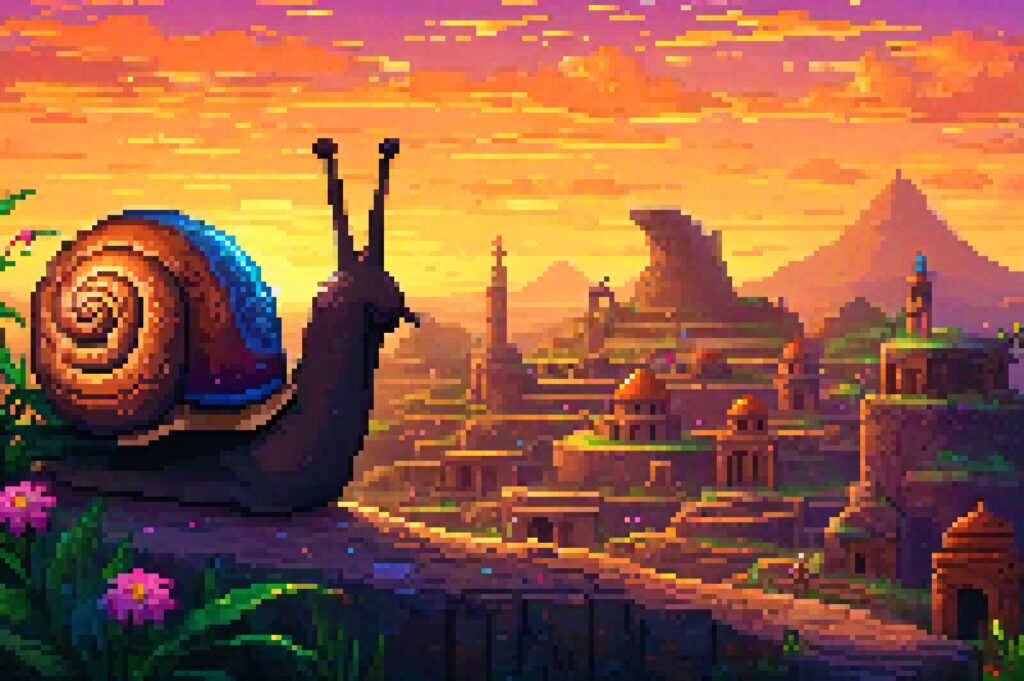
What if social media worked more like a confused snail delivering mail?Here’s the thought: what if social media didn’t run on feeds and instant replies, but on snails? You don’t post. You send a message to someone’s UID. It takes 1 to 3 days to get there. Not because the system is broken — because that’s just how long the snail takes to crawl over.
Every message includes the full conversation so far. So it’s not just one message — it’s a thread carried forward, bundled and re-bundled over time.
Sometimes, snails get confused. They deliver messages to the wrong person. Not often, but enough to make things interesting. The more people there are, the more likely this happens. That moment of misdelivery? It’s not a glitch. It’s part of how new conversations start.
The Field of Snails
Picture a field in a window. Organisms — snails — drift through with different conversation threads. Everyone is anonymous. No usernames. No profiles. You just drop messages into a snail, and let the thought travel across the world. It’s not a social graph. It’s a living system.
These snails migrate slowly. Each one moves across a grid that spans the globe. It takes 7 days for a snail to complete a full world cycle. You send a message, and it starts moving. If someone else replies to that message, the snail keeps moving. If it’s active, it speeds up — maximum cap: 2 days per cycle. If no one responds, the snail keeps crawling, slower and slower, until it dies out, the death of a thread / conversation.
You can see all the snails on the map, watching them move in real time. But you can only interact with the ones currently in your zone. Your zone is determined by your actual location and timezone, pulled from your computer.
Shell Growth and Conversation Evolution
As conversations grow, snails carry more. Eventually, the shell gets too heavy. When that happens, the snail splits. Half the shell falls off and becomes compost — gone. The rest is summarized by an LLM and becomes the start of a new thread.
That new shell? A mutation. Not a copy. Just a new snail carrying the gist of what came before. And so, conversations don’t live forever. They grow, shed, and maybe become something new.
Void Zones
Given that the grid of SoSnail is made out of the real word, with people in real locations, there will be parts of the grid that is just a complete void (like the arctic), cus penguins arn’t on social medial.
So no people equals zone of void. If a snail crawls into such a zone, AI steps in. Not to talk. Not to reply. Just to complicate. It adds weight: contradictions, questions, context. It makes the shell heavier. Harder to carry. But the snail keeps going. The idea is to diversify threads, where you get ideas from different context, different perspectives. If a shell is full of ‘flat earth content’, then the AI from the void will throw in alternate datapoint, or alternate views, to balance the thread. No bias, just pure opposites to complicate the thread.
When it reaches the next human zone, it’s up to someone else to decide — keep the thread going, or let it die.
Why This Matters
Connection, authenticity and intimacy in the internet is broken. We’re trapped in what Clare Birchall calls “shareveillance” – always already sharing, forced to be transparent. The “datafication of something” means “render things that have never been quantified before.”
SoSnail forces different timespan and intentionality. I wouldn’t call this idea useful, or productive. You can’t add links. In fact, you can’t do shit. You can only add text and bold it. Maybe it doesn’t have a 300 character limit, but it has a less than 500 words limit.
The whole point is the idea of a network that forces you to communicate with with ideas, to other people without credit, likes or fame. It’s pushing conversations back to the archetype of the old world – patient, place-based, with natural rhythms instead of algorithmic manipulation. Its like when a traveling merchant talks to people, collect stories from a campfire, and spreads the message, as it gets modified through all if his interactions.
When u send a snail, and it makes its trip around the world to come back to your zone, it comes with fresh new perspectives and ideas, with a delay.
A field in a window where organisms come by with different threads, everyone is anonymous and just drops messages. Social media as a living system.